

In recent years, there has been a significant advancement in the field of Artificial Intelligence (AI) and Augmented Reality (AR). These technologies have become increasingly popular and have the potential to enhance virtual experiences in various fields such as gaming, education, healthcare, and...
How a Neural Network Detects Irregularities in Financial Reports
96
21.08.2026
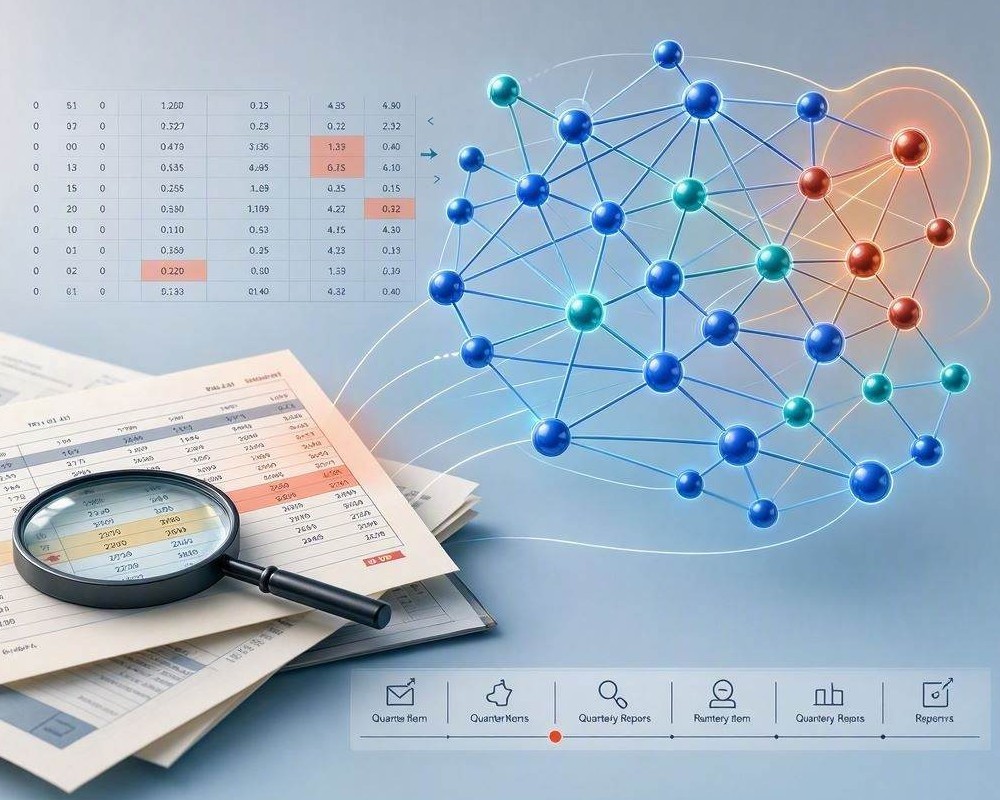
Large companies produce extensive financial reports containing income statements, balance sheets, cash flow data, disclosures, and management commentary. Reviewing these materials manually is time-consuming, while subtle inconsistencies may remain unnoticed even after a conventional audit. Neural networks offer a faster way to analyze complex reporting patterns and highlight transactions, figures, or statements that deserve closer examination.
An artificial intelligence system does not automatically prove that fraud has occurred. Instead, it identifies unusual relationships within financial data. Auditors, regulators, investors, and internal compliance teams can then investigate the flagged areas and determine whether they reflect an error, a legitimate business event, or intentional manipulation.
How Neural Networks Analyze Corporate Reports
A neural network learns from large collections of historical financial information. Training data may include audited statements, regulatory filings, accounting ratios, restatements, market indicators, and known cases of reporting misconduct. By processing these records, the model recognizes typical financial relationships across companies, industries, and reporting periods.
Structured Financial Data
Numerical analysis focuses on revenue, expenses, assets, liabilities, margins, and cash flows. The model can compare current results with prior periods, peer companies, and sector benchmarks. For example, rapidly rising revenue combined with declining operating cash flow may receive a higher anomaly score, especially when the pattern differs significantly from industry norms.
Textual Disclosures
Natural language processing allows the system to examine footnotes, risk disclosures, and executive commentary. It may detect abrupt changes in tone, vague explanations, inconsistent terminology, or language that differs from earlier reports. The technology can also compare narrative claims with reported figures, helping analysts find statements that are not fully supported by the underlying data.
Irregularities the Technology Can Identify
Financial reporting anomalies vary in severity. Some result from data entry problems or changes in accounting policy, while others may indicate aggressive reporting practices. Common warning signals include:
- Unexpected differences between earnings and operating cash flow;
- Unusual growth in receivables relative to sales;
- Repeated transactions recorded near the end of reporting periods;
- Expense classifications that differ from historical patterns;
- Abnormal relationships between subsidiaries and related parties;
- Sudden changes in estimates, provisions, or asset valuations;
- Contradictions between financial tables and management explanations.
Advanced models can evaluate several weak signals simultaneously. A single change may be reasonable, but a combination of unusual revenue timing, altered estimates, and ambiguous disclosures can justify additional scrutiny.

Benefits for Auditors and Financial Teams
Faster Risk Assessment
Neural networks can review millions of records more quickly than a human team. This capability helps auditors prioritize high-risk accounts and transactions instead of relying primarily on limited samples. Continuous monitoring can also identify issues during the reporting period rather than after annual statements have been published.
Consistent Analysis
Automated screening applies the same analytical framework across departments, subsidiaries, and reporting cycles. Consistency is particularly valuable for multinational corporations, where different accounting systems and local practices can make consolidated oversight difficult.
Limitations and Governance Requirements
The quality of detection depends on the relevance and accuracy of training data. A model trained on one industry may misinterpret normal practices in another. Corporate restructuring, acquisitions, economic shocks, and new accounting standards can also produce legitimate anomalies. False positives are therefore unavoidable.
Companies should maintain human review, document model decisions, protect confidential information, and test systems regularly for bias or declining performance. Explainable AI methods are especially important because auditors and regulators need to understand why a transaction was flagged. A risk score without supporting evidence cannot replace professional judgment.
The Future of AI-Assisted Financial Oversight
Neural networks are likely to become a standard component of audit and compliance platforms. Their greatest value lies not in replacing accountants, but in directing expert attention toward areas where mistakes or manipulation are more likely. When combined with strong governance, transparent methods, and experienced human analysis, AI can improve the speed, scope, and reliability of corporate financial review.